
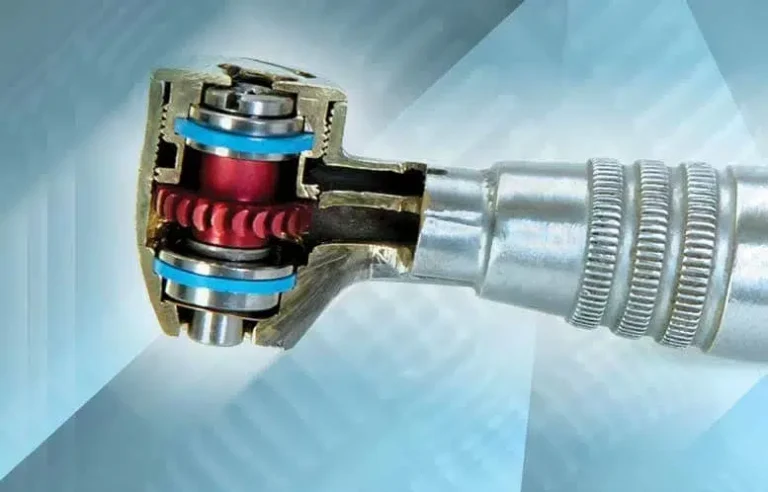
A well-maintained dental handpiece lasts three to five years or more. A neglected one lasts nine to eighteen months. The gap between those two numbers is not the brand you bought — it is lubrication, sterilization habits, and how many handpieces you keep in rotation.
That is the short version. The rest of this is what actually wears out, when each part is due, and how to tell where yours is in that cycle.
How long does a dental handpiece last?
Three to five years or more with consistent professional care. Nine to eighteen months when it is neglected.
Both figures describe the handpiece — the instrument as a whole. Inside it, individual parts wear on their own schedules, and those are the numbers that actually drive your repair bills. A handpiece does not fail all at once. It works through its wear items one at a time, and it lasts as long as you keep replacing them.
How long do handpiece bearings last?
It depends entirely on which handpiece they are in:
- High speed turbine bearings — about 1 year for most offices, up to 2 with enough handpieces in rotation
- Low speed attachment bearings — 1.5 to 3 years
- Low speed motor bearings — often 3 years or more
- Electric handpieces — the handpiece lasts 10+ years, but needs service every 1 to 2 years
None of these are failure points. They are service intervals, the same way tires are. A high speed turbine bearing reaching a year has not gone wrong; it has done its job. When it gets there, a high speed handpiece repair replaces the worn bearings or the whole turbine, and the clock starts over.
The spread across that list is not arbitrary. These are different machines doing different work. A high speed handpiece is a turbine, and it can run over 400,000 RPM. At the other end, an endo attachment is driven through a gear train and may turn a few hundred RPM. Between those two extremes sits everything else in your operatory — and the bearings wear accordingly.
The single biggest lever on that first figure is how many high speeds your practice has in circulation. One handpiece carrying every procedure sees roughly a year. Spread the same workload across enough of them and two years is realistic — same brand, same bench, same maintenance. More handpieces in rotation, not a different brand.
What actually kills a handpiece?
Running dry. Bearings die from a lack of lubrication, and lubrication is the only thing that extends their life. Everything else on this list is a variation of that or a way of accelerating it.
Over-lubrication is the other side of the same coin. Excess oil collects debris and turns into the black residue that comes out of a handpiece that has been over-oiled for months. Use the manufacturer-approved lubricant, and run the handpiece afterward so it distributes instead of pooling in the head.
Oiling a LubeFree turbine. Some turbines are sealed and lubricated at the factory and must never be oiled. One application breaks that seal permanently, and from then on it has to be oiled for the rest of its life. On a Star, the model number will not tell you which you have — that is a separate article, and it is worth reading if you run Star handpieces: Never Oil a LubeFree Handpiece.
Air pressure set too high. Excess pressure loads a turbine beyond what it was built for. It shortens bearing life quietly and consistently.
Sterilization shortcuts. The CDC calls for heat sterilizing every handpiece, and any device that attaches to the air or waterline, between patients — not wiping, not immersing. That cycle is non-negotiable, and it does put real cumulative wear on the instrument. That wear is the cost of doing it correctly, not a reason to do less of it.
Dull or badly seated burs. A worn bur adds vibration and load to a handpiece that was fine a minute earlier.
Does a handpiece stop working after a set number of sterilization cycles?
No. You will see figures like 500 to 1,000 cycles quoted as a service interval, and they are a reasonable planning number — but nothing changes at cycle 501. A handpiece that is well maintained keeps going past it. A handpiece that is not was already in trouble well before it.
Cycle counts are a prompt to have something looked at, not an expiry date.
What are the warning signs a handpiece is wearing out?
You feel these before you can measure them:
- A change in pitch — a whine, a grind, or a rattle that was not there last week
- Vibration you can feel through the handpiece under load
- Heat — the head running warmer than it used to
- Loss of power or cutting efficiency — it takes longer to do the same work
- A bur that will not seat properly, or slips under normal load
- Weak or inconsistent water spray
- Black oil on expulsion — the over-lubrication signature
For the full diagnostic list and what each symptom usually means internally, see our dental handpiece maintenance guide.
How long can I keep using a handpiece that has started making noise?
Not to the end of the day. Once a bearing starts to go it can take the head with it inside a couple of hours of use — that is between patients, not between months.
This is the part practices get wrong most often, because a noisy handpiece still works. It cuts, it polishes, the appointment finishes. But the noise means the bearing is already damaging what it spins inside, and the head is the expensive thing to damage. A bearing replacement and a head replacement are very different bills.
Swap it out and set it aside. That is the whole action.
My handpiece will not spin. What does that mean?
Three common causes, and they are not equally serious:
- No drive — the air or the motor is not reaching it. Check the coupler and the tubing before you blame the handpiece.
- A seized bearing — it has run dry or been contaminated and has locked up. This is the one that has usually taken other parts with it.
- The chuck — a bur jammed, or a chuck mechanism that has stopped releasing.
Only the first is something to check chairside. The other two are bench work.
When is a handpiece not worth repairing any more?
When the repair estimate starts approaching the cost of a replacement, and especially when it is the second or third time in a short period.
That is a judgment call rather than a rule, and it is one we would rather make with you than for you. If we open a handpiece and it is not worth doing, there is no repair charge at all — a flat $29 covers shipping and handling and it comes back to you.
How do I make my handpieces last longer?
In order of how much difference each one makes:
- Lubricate correctly, every time. Not more, not less. This is the whole ballgame.
- Keep enough handpieces in rotation — seven to ten per operatory — so none of them goes straight from the autoclave back into a patient’s mouth. The point is not having spares. It is buying the time to clean and lubricate each one properly.
- Heat sterilize between every patient, following the manufacturer’s instructions for your model.
- Have your air pressure checked rather than assumed.
- Change burs before they are dull.
- Send it in when it changes, not when it stops.
How often that last one comes up depends on your practice, not on a calendar — we wrote that up separately: how often should you service a dental handpiece.
Should I repair or replace?
Repair, in most cases, for longer than practices expect. It helps to know what is actually being replaced.
The head is the shell at the working end of the handpiece. It is not a wear part and it is not rebuilt. What sits inside it is:
- On a high speed handpiece, a turbine. The worn one comes out, a new one goes in.
- On a low speed handpiece or an electric, a head cartridge. Same principle.
Those are the parts designed to be replaced, and there is no fixed number of times you can do it.
This is also the real reason a failing bearing is worth acting on the same day. While the damage stays inside the turbine or the cartridge, you are replacing a part that was always going to be replaced. Once it reaches the head it is holding, you are into a different repair — because the shell is not something that gets rebuilt.
The case for replacing the whole handpiece is when the head itself is damaged, when parts are no longer available for the model, or when repairs start following each other too closely.
Frequently asked questions
How long does a dental handpiece last?
Three to five years or more with consistent professional care, versus nine to eighteen months when neglected. The difference is maintenance, not brand.
How long do high speed turbine bearings last?
About a year for most offices. Two years is achievable if the practice keeps enough high speed handpieces in circulation that no single one carries the whole workload.
How long do low speed handpieces last?
Low speed attachment bearings typically run one and a half to three years, and low speed motor bearings often three years or more. Low speeds outlast high speeds because they are driven through a gear train rather than a turbine — a different mechanism with a different wear pattern. The speeds are not comparable either: a high speed turbine can exceed 400,000 RPM, while an endo attachment may turn only a few hundred.
How long do electric handpieces last?
The handpiece itself can last ten years or more, but it needs servicing every one to two years to get there.
What is the most common cause of handpiece failure?
Running dry. Bearings fail from lack of lubrication, and lubrication is the only thing that meaningfully extends their life.
My handpiece is noisy but still works — how long do I have?
Hours, not weeks. Once a bearing begins to fail it can damage the head within a couple of hours of use, sometimes between one patient and the next. Take it out of service the same day.
Does a handpiece expire after 500 sterilization cycles?
No. That figure is a planning interval, not a limit. Nothing changes at cycle 501 — a well-maintained handpiece keeps going past it, and a poorly maintained one was already failing before it.
How many handpieces should a practice have per operatory?
Seven to ten in rotation, so each one has time to be cleaned and lubricated properly before it goes back into service.
Can a handpiece head be rebuilt?
No. The head is the shell at the working end of the handpiece, and it is not a wear part. What gets replaced is what sits inside it — a turbine on a high speed, a head cartridge on a low speed or an electric. That is why a failing bearing is worth acting on the same day: while the damage is confined to the turbine or cartridge you are replacing a part that was always going to be replaced.
When should a handpiece be replaced rather than repaired?
When the head or body itself is damaged, when parts are no longer available for the model, or when repairs are recurring in quick succession.
About this answer
Written by Bill Traynor, master technician and owner of Essential Handpiece Repairs in Colorado Springs. We have been rebuilding dental handpieces for practices nationwide since 2019 — high speed, low speed, electric, and the attachments that go with them.
If something in your operatory is starting to sound wrong, send it in and we will tell you what it is. Free prepaid shipping label, a written figure before any repair, and a 6-month parts and labor warranty.
Get a free shipping label → | See repair pricing →
This post is for educational purposes. Always consult manufacturer instructions and your equipment specialist for model-specific advice.