
Low Speed Handpiece and Motor Repair
Why Practices Trust Us With Their Motors
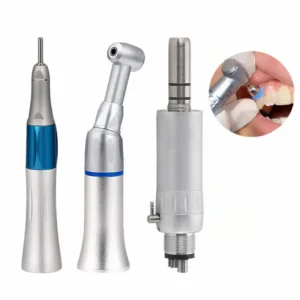
The motor spins. The attachment does the work. Low speed or slow speed, whichever your office calls it, we rebuild both — contra angles, prophy heads, straight attachments, nose cones and the motors they thread onto — and we test them mated together, the way you actually use them.
7+ Years on the Bench
7+ Years on the Bench
6-Month Warranty
6-Month Warranty
20+ Motors & Attachments
20+ Motors & Attachments
The Motor and the Attachment Are Two Different Repairs
Almost every low speed complaint that reaches our bench arrives labeled “motor problem,” and most of the time the motor is fine. It is worth understanding why, because it changes what you send us and what you pay. A dental motor is a sealed rotor turning on two bearings, buried inside the handle where nothing touches it. The attachment on the front is a gear train, a second set of much smaller bearings and a chuck — sitting at the wet end, taking side load from the bur, and going through the autoclave twice a day. One of those two things is doing all the hard work, and it is not the motor.
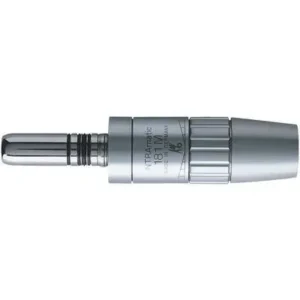
The motor
A sealed rotor on two bearings, and the threaded nose that everything else mounts to
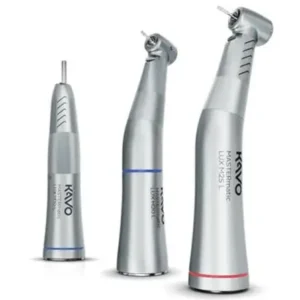
The attachments
Straight attachment, contra angle and speed-increasing head — all the same E-type mount
The Motor — the powered base
Air-driven or electric, the motor produces rotation and passes air, water and sometimes light forward through the face of its coupling. It is the simplest half of the pair.
What actually fails: rotor bearings, vane wear on air motors, brushes on older electrics, a perished O-ring at the tubing connection, and — most often of all — the threads on the nose where attachments mount.
How it announces itself: a change you can hear with no attachment fitted at all. Pull the angle off, run the motor bare and listen. A healthy motor is a smooth, even tone.
The Attachment — the working head
Contra angles, prophy heads, straight attachments and sheaths all mount to the same standard interface, which is why they are interchangeable between brands.
What actually fails: the drive gears, the small head bearings, the latch or chuck that holds the bur, the internal drive shaft, and the seals that keep water out of the gear case.
How it announces itself: wobble at the bur, a bur that will not stay latched, roughness you can feel through your fingertips, and noise that appears the moment the attachment goes on. Hygiene handpieces are the same story with a prophy cup on the end — see Young and Denticator handpiece repair.
If the noise is there with the attachment off, it is the motor. If it appears the moment the attachment goes on, it is the attachment. That thirty-second test tells you more than any symptom list will.
How Attachments Mount on a Motor
Low speed handpieces are modular by design, and that design is older and more standardized than most practices realize. Understanding the connection explains most of what goes wrong with it.
- One standard interfaceNearly every dental motor and attachment made in the last forty years uses the same E-type connection defined by ISO 3964. That is why a contra angle from one manufacturer threads onto a motor from another. It is a genuine standard rather than a coincidence, and it is the reason we can bench-test your angle on a known-good motor to isolate a fault.
- The drive spindle carries the rotationIn the center of the motor nose sits a small square or lobed spindle, and the attachment’s drive shaft slots over it. Nothing clamps the two together — the fit itself transmits the torque. Once that fit goes sloppy from wear you get lost power, chatter, and eventually a rounded spindle that will not drive anything at all.
- The ring of ports carries everything elseAround that spindle is a face full of small openings for air, water and, on optic motors, light. Each one is sealed by an O-ring. A motor that sprays from the joint, or an angle with no water reaching the bur, is very often nothing more than a dollar’s worth of perished O-rings.
- The threads hold it all in placeThe attachment screws onto the motor nose, and those threads take the load of every install, every removal and every autoclave cycle for years on end. They gall, they wear loose, and eventually the attachment sits at an angle or works itself off during a procedure.
Nose Cones, Explained
That repair is about the mounting interface, not the motor’s internals. The nose cone is the front section of the motor that carries the threads and the spindle bore — the part every attachment screws onto and comes off again, twice a day, for years. When those threads gall or wear loose, attachments stop seating square and start working themselves free mid-procedure. We replace the nose cone, which restores a clean mounting face without touching the motor’s internals. It costs a fraction of a new motor, and it is frequently what a practice is actually paying for when they believe they need one.
Why Sending the Motor Alone Wastes a Repair
Send us the pair. We can bench a motor on its own and confirm that it runs, but we cannot reproduce your wobble, your noise or your play without the attachment that was on it — and the fault is usually in that attachment anyway. Sending one half means we either return a motor that tests fine and have solved nothing, or we rebuild the attachment and never check whether the worn spindle it was sitting on is what chewed it up in the first place. Motor and attachment wear as a system, so we test them as one.
Which Part Is Actually Broken?
Run through this before you box anything up. It takes under a minute and it usually names the culprit — which means you know what you are sending and roughly what to expect before you ever pick up the phone.
| What you notice | Almost always | Worth checking |
|---|---|---|
| Noise with the attachment removed | Motor bearings | Air pressure and moisture in the line |
| Noise only once the attachment is fitted | Attachment gears or head bearings | Whether it does it on a second motor too |
| Bur wobbles or has visible play | Head bearings or drive shaft in the attachment | Bur shank for burrs and bends |
| Bur will not stay latched | Worn latch or chuck in the attachment | Correct bur type for that head |
| Attachment feels loose or sits crooked | Worn motor nose cone | The attachment’s own thread face |
| Water at the joint instead of the bur | Perished O-rings at the coupling face | Blocked water port in the attachment |
| Power drops but it still spins | Rounded drive spindle or worn gears | Motor air pressure at the handpiece |
| Runs hot to the touch | Dry or failing bearings, either half | Lubrication routine and volume |
What Low Speed and Motor Repairs Cost
Low Speed Angles Starts at $145
Gears, head bearings, drive shaft and seals renewed. Push-button heads get a new cartridge. Latch retention pull-tested before it ships.
Motors and Nose Cones from $169
Bearing and brush service, worn nose cones replaced, then run-tested across the full speed range.
Attachments Starts at $269
Straight attachments, sheaths and adaptors — shaft bearings, chuck and interface rebuilt, then run mated to a motor.
Low speed angle rebuilds start at $145, motor work starts at $169, and straight attachments, sheaths and adaptors start at $269. Every quote covers parts, labor, cleaning and a full performance test under our 6-month parts and labor warranty, and you get a written estimate before any work begins. If a piece turns out not to be worth repairing there is no repair charge at all — a flat $29 covers shipping and handling and it comes back to you. See full pricing by brand and model.
Motors, Angles and Attachments We Service
This is our regular bench work, not the limit of what we take in. If yours is not on the list, call (720) 998-2820 and ask. We repair every major brand of high speed and electric handpiece as well — see the handpiece brands we repair, our high speed handpiece repair page and our electric handpiece repair page. We rebuild low speed gear on every major brand: KaVo, Midwest, Star, NSK, Adec and W&H, Bien-Air, Beyes and Young hygiene handpieces. Rotary endo heads that mount on an E-type motor are covered on our endo and surgical handpiece repair page, and full rates are on our repair pricing page.
Low Speed Angles — Starts at $145
- KaVo Angle Rebuild
- Latch Angle Rebuild
- New Ball Bearing Angle
- PB Angle New Cartridge
- PB Latch Angle Rebuild
Contra angles take more abuse than anything else in the operatory, and they are also the most rebuildable thing we handle. A rebuild renews the gears, the head bearings, the drive shaft and the seals. On push-button heads we fit a new cartridge rather than replacing the whole angle, which keeps the cost well down. Latch heads get their retention pull-tested before they leave, because a latch that lets go mid-prophy is the complaint we hear most often.
Motors and Nose Cones — from $169
- KaVo Motors
- Lynx Motors
- Micro Motors
- Micromite
- Champion Little Guy
- Nose Cones
Motors come to us for bearing noise, lost power and — most commonly of all — a worn mounting interface. We service KaVo and Lynx motors alongside micro motors, the Micromite and the Champion Little Guy. Nose cone replacement is quoted on its own, because it is so often the entire repair rather than part of one.
Straight Attachments and Sheaths — Starts at $269
- Straight Attachments
- Midwest Contra Sheath
- Star Angle Adaptor
Straight attachments run a single long drive shaft instead of a gear head, so they fail differently — shaft bearings and the chuck at the tip rather than gear wear. Sheaths and adaptors are the outer bodies and interfaces everything else lives inside: a Midwest contra sheath that has gone oval will destroy a good cartridge within weeks, and a worn Star angle adaptor introduces play that reads on the bench exactly like a bad head.
How to Send Us Your Motor and Attachment
Five steps, and four of them are ours. The part you handle should take minutes.
- Ask for a label. Start on our Book My Repair page and a prepaid USPS label reaches you the same business day — no minimum order and nothing to pay up front.
- Send both halves. The motor and the attachment that was running on it, together in one box, with a note naming your practice and describing the symptom. This single thing does more to improve a low speed repair than anything else you can do.
- We look, then we quote. Inspection is free, and nothing gets opened past that point until you have a written price and have approved it.
- We rebuild and prove it. Cleaned, rebuilt, then run mated — torque, latch retention, water spray and runout all checked with the attachment on the motor rather than each tested on its own.
- Back to your operatory. UPS or FedEx, 2–3 business days on the bench, under the 6-month parts and labor warranty.
Frequently Asked Questions
The questions practices ask most before sending us a motor or a low speed attachment. Shipping, warranty and the other general questions are covered on our dental handpiece repair FAQ.
Is it my motor or my low speed attachment?
Nearly always the attachment. Pull it off and run the motor bare for a few seconds: if the noise or roughness disappears, the motor is fine and the attachment is your repair. If the motor still sounds wrong on its own, it is the motor. Either way, send us both — the fault is often in how the two meet, and we cannot test that with only one half on the bench.
My attachment will not stay tight on the motor. What is that?
Almost always a worn nose cone — the front section of the motor that carries the mounting threads. Every install, removal and autoclave cycle wears them, and once they go the attachment sits crooked or works itself loose while you are using it. We replace the nose cone, which gives you a clean mounting face again for a fraction of the cost of a new motor. Send the motor and the attachment together so we can check the fit on both halves.
Can you rebuild a push-button contra angle?
Yes. On push-button heads we fit a new cartridge rather than replacing the whole angle, which keeps the cost down, and we pull-test the button retention before it ships. Latch-type angles get rebuilt with new gears, bearings and seals.
Will an attachment from one brand fit a motor from another?
Usually, yes. The E-type connection defined by ISO 3964 is shared across nearly every dental motor and attachment made in the last forty years, so mixing brands is fine mechanically. It also means a worn motor spindle can quietly wear out a perfectly good angle from a different maker — another reason to send us the pair.
How long does a low speed repair take?
2–3 business days on the bench. Add transit each way — typically a couple of days in each direction on the prepaid label, though that part is the carrier’s clock, not ours. We will tell you at the estimate stage if a part needs sourcing and the timeline is going to move. Getting it to us is free on our prepaid USPS label; the return trip goes out via UPS or FedEx.
What does a low speed handpiece repair cost?
The split between motor and attachment decides the bill. Attachment rebuilds — contra angles, prophy heads, straight attachments — start at $145. A motor rebuild starts at $169, and more involved low speed work starts at $269. Coupler replacement starts at $129. Because the fault so often lives in the attachment rather than the motor, plenty of repairs land at the $145 mark instead of the motor price — one more reason to ship both halves and let the bench tell you which one is actually broken. Your written figure comes before any work, and pricing by brand and model shows where yours falls.