
Sonic Scaler Repair
Most practices call every scaler an ultrasonic. If yours threads onto your handpiece tubing, we rebuild it — from $239, 2–3 business days on the bench, nationwide mail-in from Colorado Springs. If it plugs into a countertop generator instead, we will tell you that before you ship anything.
- From $239
- Flat 6-month parts & labor warranty
- 2–3 business days on the bench
- Free prepaid shipping label
Which One Do You Actually Have?
Nearly every practice that calls this bench says “ultrasonic.” Most of the time the instrument in their hand is a sonic scaler: it threads onto the handpiece tubing, runs on line air, and has no electronics in it at all. A true ultrasonic is an electric instrument tethered to its own generator box on the counter. They feel similar in the hand and they are completely different machines inside — which only starts to matter once one of them stops working.
The connector end settles it in a second. Threads onto a handpiece coupling: sonic, and we rebuild it from $239. Cord running to a countertop unit: ultrasonic, and it belongs with a shop that has the matching generator to test against. If you are not sure which you are holding, send us a photo of the connector — sorting that out by email costs nothing, shipping the wrong instrument costs you a week.
Sonic — what we rebuild
Threads onto your handpiece coupling and runs on line air. Titan, StarDental K and SW, and equivalents. No electronics, no generator.
Ultrasonic — not this bench
Cavitron, piezo and similar: an electric handpiece tethered to a generator unit. Different internals, different repair.
Models We Service
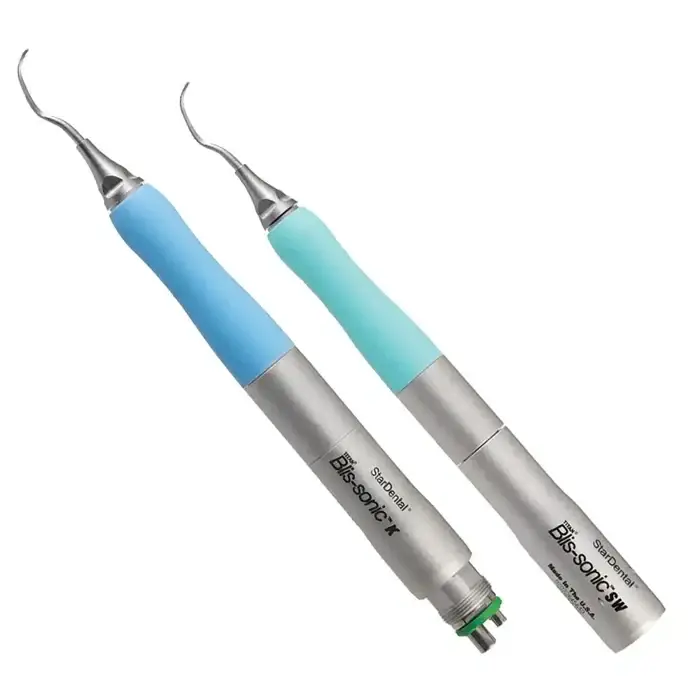
StarDental Titan sonic scalers — including the K and SW models pictured — plus other air-driven scalers that mount on a standard handpiece coupling. If you are unsure what you have, send a photo of the connector end and we will tell you before anything ships.
We also repair the rest of the Star and StarDental line, so a scaler and a handpiece can travel in the same box on one label.
Why Your Scaler Feels Weak
Most “weak scaler” complaints that reach this bench are not a failed scaler. In order of how often we find them: air pressure, a worn tip, a blocked water port, and only then internal wear. Work down that list before you condemn the instrument.
The air pressure at the coupling is low
A sonic scaler converts line air into tip movement, so pressure and performance are directly linked in a way they are not on a high-speed. Drop below the pressure the scaler was designed for and it goes soft — while every other instrument on the same unit still feels fine, because they tolerate the loss better. Check pressure at the coupling before assuming the scaler is the problem.
The tip is worn out
Scaler tips are consumables, not permanent parts. The working end wears with use and loses its bite, and a worn tip on a perfectly healthy scaler feels exactly like a dying scaler. This is the single most common reason a practice sends us an instrument that turns out to be fine.
The water port is blocked
Scale and residue restrict the water channel. Flow drops, the tip runs hotter and cuts worse, and patients feel it before the operator does. We clear the channel on every scaler that comes through.
Internal O-rings and seals are worn
This is the actual repair. Seals harden and leak, air escapes where it should be doing work, and amplitude falls off. It is a rebuild, not a replacement instrument.
The tip threads are damaged
Cross-threading a tip is easy to do and it damages the seat on the scaler, not just the tip. Once the seat is chewed, tips will not seat square and the instrument loses power. Catch it early and it is repairable.
What We Actually Do to It
Stripped and rebuilt
O-rings and seals renewed, the air path cleared, and the internals cleaned of everything the autoclave baked on.
Water channel cleared
The water port and channel cleared and flow-checked, so the tip runs cool and cuts the way it should.
Tip seat inspected
Threads and seat checked and corrected where possible, so tips seat square and transfer full power.
Tested under working pressure
Run at operating pressure with a tip fitted before it ships — not bench-blown for a second and boxed.
Scaler Repair Pricing
How to Send Us Your Scaler
1. Ask for a label
Request one on our Book My Repair page — free prepaid shipping label, emailed the same business day.
2. Send a tip with it
Send at least one tip you actually use — we test the scaler with a tip fitted, and a worn tip is often the whole story.
3. Free evaluation
What it needs and what it costs, before any work begins. If the scaler is fine and the tip was the problem, we tell you that.
4. Back in 2–3 business days
Bench time is 2–3 business days, under a flat 6-month parts and labor warranty.
Always ship with the prepaid label we email you — it is how we identify, track and cover your instrument in transit. Warranty, turnaround and the other general questions are answered on our dental handpiece repair FAQ.
Frequently Asked Questions
Do you repair Cavitron or piezo ultrasonic scalers?
No. We repair air-driven sonic scalers — the kind that thread onto a handpiece coupling. Cavitron and piezo units are electric instruments run from a separate generator and need a shop set up for that work.
How do I tell if my scaler is sonic or ultrasonic?
Look at the connector end, not the handpiece. Threads onto the same coupling as your high-speed: sonic, and we rebuild it. Cord running to a box on the counter: ultrasonic. One more tell — a sonic scaler changes pitch when you adjust the air pressure at the unit, because air is all that drives it. An ultrasonic does not react to air at all.
How much does scaler repair cost?
From $239, quoted before any work starts. It covers the rebuild, water channel service, tip-seat inspection and testing under working pressure.
My scaler feels weak — is it broken?
Often not. Check the air pressure at the coupling first, then the tip. Tips are consumables and a worn tip feels exactly like a failing scaler. Those two account for most of the weak-scaler instruments we see.
Should I send tips with the scaler?
Yes — at least one tip you actually use. We test with a tip fitted, and it lets us tell you whether the tip or the scaler was the real problem.
How long does it take?
Bench time is 2–3 business days. Transit is the carrier’s clock, typically a couple of days each way on the free prepaid label we send you.
What if it cannot be repaired?
We tell you at the evaluation stage, before any work or charges, and you decide whether to proceed.
Send your scaler in
From $239, free evaluation, and a prepaid label in your inbox the same business day.