
W&H Handpiece Repair
Synea, Alegra, contra-angles and Roto Quick couplings — rebuilt to W&H specification by one technician, then tested under load. Nationwide mail-in from our Colorado Springs bench.
- Flat 6-month parts & labor warranty
- 2–3 business days on the bench
- Free prepaid shipping label
- Free evaluation
Why W&H Repairs Go Wrong Elsewhere
W&H builds to tighter internal tolerances than most of what crosses this bench, and that changes what a correct repair looks like. A W&H head fitted with generic bearings will run — often well enough to pass a free-spin test on the day — and then fail early, sometimes taking the spindle with it. The clearance that makes a Synea feel precise is the same clearance that leaves no margin for a bearing that is nearly right.
Fitted to W&H specification
The dimensional tolerance is the point of the instrument — so bearings, chucks and seals are fitted to W&H specification, not to whatever is close enough to fit.
Tested under load, never free-spinning
A worn gear train sounds flawless with nothing pressing against it, then ticks the instant a bur meets enamel. Free-spin testing passes units that fail chairside.
Which W&H Handpiece Do You Have?
W&H names its lines rather than numbering them, and the names carry across generations — which is why practices ship us a “Synea” without knowing which one. The distinction changes the service.
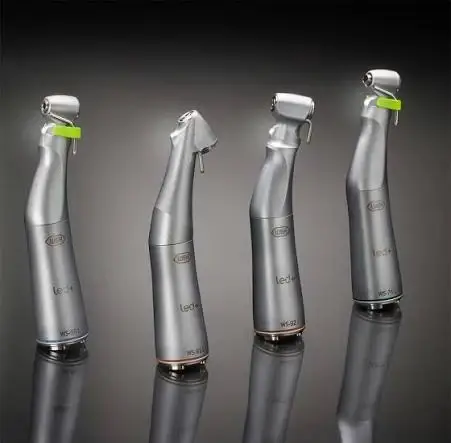
| Line | How to identify it | What fails first |
|---|---|---|
| Synea Vision | The premium line. Fiber-optic; TA/TG prefix on the shank. | Bearings — and the fiber-optic rod clouds on its own schedule |
| Synea Fusion | The line beneath Vision, same body language, fewer optics options. | Bearings, then chuck grip |
| Alegra | The value line — usually a practice’s second set. | Bearings, accelerated: spares live harder lives than mains |
| Contra-angles | Ratio marked on the body; a colored ring denotes the gearing. | Gear train, then seals |
| A-dec-branded | Sold as A-dec (WK-93, WA-99-LT and similar). | Identical internals — see below |
Is A-dec the same as W&H?
For handpieces, effectively yes — A-dec’s handpieces are built by W&H. That is why the two names sit together on repair menus, including ours, and why a practice running both brands is running one set of internals under two labels. Our A-dec & W&H page covers the A-dec model numbers directly.
Why does a 1:4.5 contra-angle wear faster than a 1:1?
Because it is multiplying speed, and the gear train pays for it. A speed-increasing attachment spins the bur faster than the motor driving it, so its gears run at higher rpm and carry more stress every hour than a 1:1 doing the same clinical work. Practices are often surprised that their speed-increaser needs service first — the colored ring is the clue to why.
Why Is My W&H Handpiece Losing Power?
Most W&H power loss is worn turbine bearings, and W&H’s tight build makes the early warning quieter than on other brands — the tone changes before the performance does. Here is how the common symptoms sort out on the bench. The same service detail lives on our high speed and electric handpiece repair pages.
The pitch has changed but it still cuts
Bearings, at the earliest stage — and the cheapest moment to fix it. On a W&H the note goes slightly rough before any loss of cutting power is obvious. Practices that act on sound rather than performance get bearing-only rebuilds; practices that wait get bearings plus whatever the vibration has worked on since.
The bur slips or will not seat fully
Chuck wear. The collet has lost grip on the shank, and no amount of pushing the bur in harder will restore it. On a W&H this is a new turbine with a new chuck ($159), not a replacement handpiece.
The light has gone dim or yellow
On fiber-optic Synea models the light path is a glass rod, and it clouds. Autoclave cycles, cleaning chemicals and residue fog the optical surfaces, so what reads as “the bulb is dying” is usually the rod and its end faces.
The contra-angle is noisy under load but fine free-spinning
Gear wear. A worn gear train can sound perfectly healthy spinning with nothing against it, then tick or grind the moment a bur meets a tooth. This is why we test attachments under load rather than free.
The Roto Quick Coupling — the half nobody sends
W&H’s Roto Quick coupling is a wear item, and it is the most common reason a correct repair appears not to have worked. The coupling carries air, water and light between the tubing and the handpiece. Its O-rings harden and its light path clouds on exactly the same autoclave schedule as the handpiece itself — so a perfectly rebuilt turbine mated to a tired coupling still runs low on air and dim on light, and the practice concludes the repair failed.
If a W&H has been misbehaving, ship the coupling with it. Testing the pair is the only way to know which half is at fault, it costs nothing extra — and it is more often than practices expect the cheaper of the two answers.
The Fiber-Optic Light Path
A dimming or yellowing light on a fiber-optic Synea is usually not a dying bulb — it is the glass rod and its end faces clouding. Autoclave cycles, cleaning chemicals and residue fog the optical surfaces gradually, so the light fades over months rather than failing outright, and the practice adapts without noticing.
It is serviceable, and worth servicing: the light is half the reason to own a fiber-optic W&H, and a clouded rod is not a reason to replace the instrument. We service the light path as part of a rebuild, which is why practices often report the returned handpiece looks brighter than they remembered.
W&H Repair Pricing
Flat published rates, identical for every practice, quoted before any work starts.
We rebuild every major handpiece brand on the same terms and the same bench. If your operatory runs more than one, see our KaVo, Midwest, Star, NSK, A-dec and W&H, Lares, Bien-Air, Beyes, Brasseler, Young and Impact Air 45 handpiece repair pages, or browse our dental handpiece repair overview.
High-Speed Turbine Rebuild — from $129
Synea and Alegra turbines: bearings and O-rings replaced, chuck inspected, spindle checked for the wear vibration leaves behind, then speed-tested.
Contra-Angles & Low-Speed — from $145
Stripped to the gear train, rebuilt as needed, then run under load so torque loss shows up here rather than chairside.
Electric Handpieces — from $229
The basic rebuild replaces the shaft gear or head gear and bearings, plus springs, spacers and O-rings, then it is calibrated against the motor before it ships.
How to Send Us Your W&H Handpiece
1. Ask for a label
Free prepaid shipping label, emailed the same business day.
2. Send the coupling too
If the handpiece has been misbehaving, include the Roto Quick — we test the pair.
3. Free evaluation
What it needs and what it costs, before any work begins.
4. Back in 2–3 business days
Bench time is 2–3 business days, under a flat 6-month parts and labor warranty.
Always ship with the prepaid label we email you — it is how we identify, track and cover your handpiece in transit.
Frequently Asked Questions
Do you repair A-dec handpieces too?
Yes — A-dec’s handpieces are manufactured by W&H, so they are the same instruments under different branding. Our A-dec & W&H page covers the A-dec model numbers.
Can you restore the light on a fiber-optic Synea?
Yes. A dim or yellow light is usually a clouded fiber-optic rod rather than a failed bulb, and the light path is serviced as part of a rebuild.
Should I send the Roto Quick coupling with the handpiece?
If the handpiece has been misbehaving, yes. The coupling carries air, water and light, and a worn one will make a healthy handpiece look sick. Testing the pair costs nothing extra.
Do you use quality W&H parts?
We fit components to W&H specification. Generic bearings in a W&H head will run for a while and then fail in a way that can take the spindle with it.
How long does a W&H repair take?
Bench time is 2–3 business days. Transit is the carrier’s clock — typically a couple of days each way on the free prepaid label we send you.
What if it cannot be repaired?
We tell you at the evaluation stage, before any work or charges, and you decide whether to proceed.
Ready to send your W&H in?
One technician, flat published rates, and a free prepaid label in your inbox the same business day.